
The Problem Everyone Is Talking About – But Few Are Solving
Process Builder powered automations across thousands of orgs for nearly a decade – field updates, email alerts, chained processes, time-based actions. It’s everywhere and now it is time to move forward.
Salesforce has made it official: Process Builder is being retired. The shift to Flow isn’t optional – it’s happening now. On paper, it sounds manageable. In reality, it rarely is.
Here’s where it gets uncomfortable: a typical mid-size Salesforce org has anywhere from 20 to 150+ active Process Builders. Enterprise clients? Hundreds. Each one needs to be analysed, understood, converted, tested, and deployed – without breaking live business processes that Sales, Service, and Operations teams depend on every single day.
In our experience, each Process Builder can take anywhere from a few hours to a full day to manually migrate, depending on its complexity. A client with 50 Process Builders is looking at a significant manual effort – weeks of consultant time before a single Flow is in production.
This isn’t a small inconvenience. It’s a significant delivery risk, a scoping nightmare, and for many clients, a source of real anxiety about what gets missed or broken.
Who Feels the Pain?
This challenge cuts across the entire Salesforce ecosystem:
Salesforce Admins are drowning in backlog they don’t have the bandwidth to clear. Many of them built these Process Builders years ago and are now being asked to rebuild them in a tool that works differently, with a syntax they’re still learning.
This isn’t just a migration. It’s a productivity bottleneck, a learning curve, and a growing risk – all at once.
Implementation partners, including us, are being asked to scope migrations that are difficult to estimate accurately. You don’t know what you’re dealing with until you’ve opened every single Process Builder and mapped its logic.
That’s not a discovery call conversation. That’s days of audit work before a single line gets written.
Business stakeholders carry the highest risk of all. They don’t care about the technical complexity; they only care that nothing breaks. Their lead assignment rules still work, their renewal alerts still fire, and their onboarding sequences don’t silently break the night you flip the switch.
Because in their world, “migration success” doesn’t mean code deployed, it means nothing broke.
Introducing KeoFlow – Solution to PB – Flow challenges
KeoFlow is a Python-based migration tool built entirely in-house at Keonos, designed to accelerate and de-risk Process Builder migration.
KeoFlow is built on a structured five-step approach that systematically converts, validates, and prepares legacy automation for safe deployment –

It gives every stakeholder – admins, partners, and business teams – the clarity and control they need to move forward without disruption or guesswork.
- Admins get automated conversions and clear, actionable visibility instead of overwhelming manual analysis.
- Implementation partners get full org-level insight, accurate scoping, and predictable effort distribution before any build begins.
- Business stakeholders get confidence that critical automations continue working without disruption.
What makes it different?
KeoFlow’s AI layer that understands your business logic.
It reads the generated Flow logic, checks whether the converted criteria and actions match what the original Process Builder intended, flags anything that looks like a mistranslation, and produces a list of suggested test scenarios specific to that Flow. It’s not a generic lint check – it’s reviewing the business logic. In our testing, it caught field mapping issues and missing conditions that would have gone unnoticed until something broke in production.
Instant Clarity with Complexity Ratings
Instead of fragmented visibility, KeoFlow provides a complete migration intelligence layer.
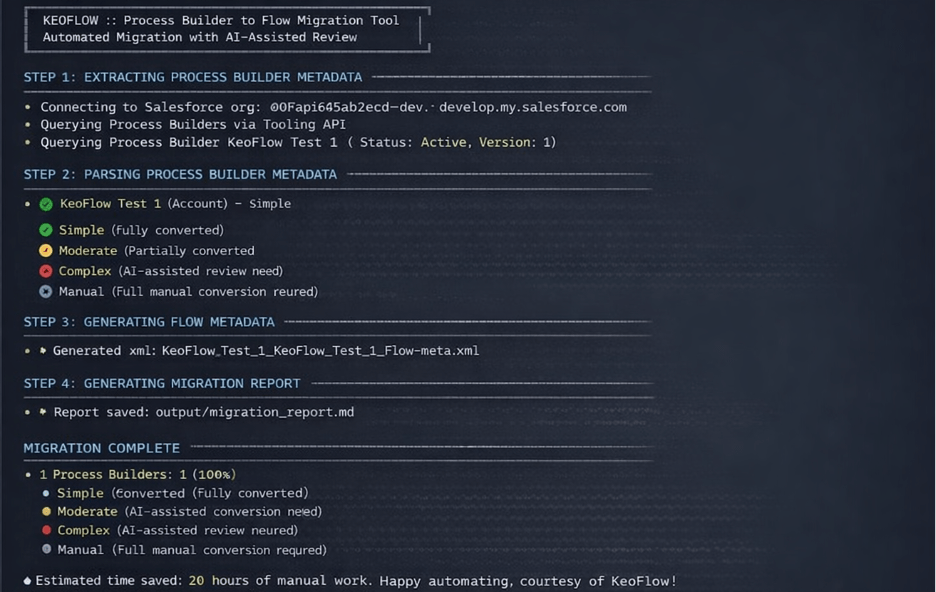
After every run, KeoFlow generates a full migration report – the exact name of every generated Flow, which object it runs on, what trigger it uses, its complexity rating, what was auto-converted cleanly, and a clear list of what still needs manual attention before activation. One document that tells your team exactly where to focus.
At the core is a 4-tier complexity model that removes guesswork from planning:
- Simple: Deploy and activate as-is.
- Moderate: 95% complete, requires quick review
- Complex: Scheduled actions, cross-object updates, or process chains involved. KeoFlow handles most of it, but flags what needs human eyes.
- Manual: Apex-dependent logic that must be rebuilt manually
For example, knowing upfront that 60% of your client’s PBs are Simple, 30% are Moderate, and 10% need manual work changes every conversation, from scoping, to staffing, to setting client expectations.
What Made This Hard to Build?
We built KeoFlow because we couldn’t find a tool that handled all these edge cases reliably. A basic Process Builder parser isn’t difficult – there are open-source attempts out there. What’s genuinely hard is handling the scenarios that silently break production automations if you get them wrong.
The results of getting those hard cases right: scheduled actions convert with the correct time offsets and source fields rather than leaving a placeholder. Cross-object updates include the lookup step that Flow actually requires to find the related record – skip it and the Flow errors at runtime. Process chains resolve correctly, so the whole connected sequence migrates as a unit. ISCHANGED conditions map to the right Flow equivalent rather than getting dropped or mistranslated.
After every run, the migration report surfaces anything that still needs a human decision before deployment. The conversion step no longer takes days. The review and validation step – which still needs to happen, and should happen – is what the team focuses on instead.
Key Takeaways
The Process Builder sunset is not a distant threat. Clients are already asking questions, and the partners who have credible answers will win the work.
Manual migration at scale is a solved problem, if you have the right tooling. Organisations that approach it as a routine implementation project will struggle to compete on speed and quality delivered by partners who leverage automation as a core capability.
AI review is not a buzzword in this context. It’s a specific check on specific logic and on a long migration, it catches the mistakes that come from fatigue and familiarity, not incompetence.
In-house tooling is a strategic asset. It signals that Keonos invests in engineering, not just delivery. That’s the kind of partner, clients trust for long-term engagements.
Sitting on 50+ Process Builders and a deadline? Still getting migrations scoped, the manual way? A ticking deadline? A scope you can’t accurately get a quote for?
That’s exactly the problem Keonos built KeoFlow to solve and we’re ready to solve it for you. Let’s connect.
Did you find this blog helpful?

Rishabh Jain is a Salesforce Technical Consultant at Keonos. With 4+ years of experience working with global clients, Rishabh specialises in delivering end-to-end Salesforce solutions that are built to scale. His work spans multiple Salesforce clouds – Sales, Service, Health, and Financial Services – with deep expertise across configuration, customisation, integrations, and administration.
He holds 5 Salesforce certifications and 2 Copado certifications, and brings a strong focus on improving system efficiency and performance for every engagement he takes on.